 Everyday growing
Bella’s Bedtime Wobbles
Explore bedtime worries and choose comforting steps together.
Get this free pack Collyvale
A little place for big feelings.
Collyvale
A little place for big feelings.
Free printable pack · Fussy eating
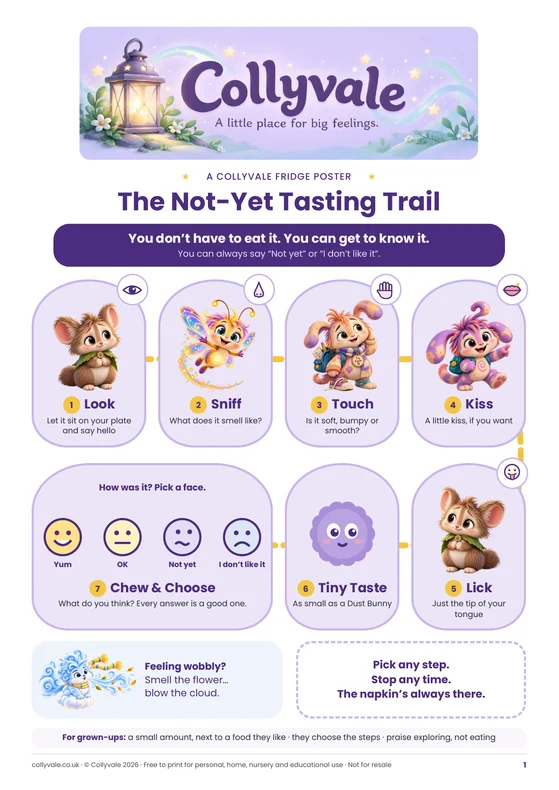
Gentle fussy eating printables built on one simple idea: you don’t have to eat it, you can get to know it. Help your child meet new foods without pressure, one small step at a time.
Email me this packFree · Printable PDFs · No book needed
Your pack arrives as three free downloads. Start with the toolkit, share the story together, and dip into the extras whenever your child fancies them.
Looking, sniffing and touching all count, and “not yet” is always a fine answer. Nobody has to eat anything.
Pop in your email and we'll send the download links straight to your inbox.
This pack is for children aged around 3 to 7 who find new foods tricky, and for the grown-ups who sit beside them at mealtimes. Fussy eating is a very common, normal stage. The aim isn’t a clean plate: it’s calm, curious meetings with food, again and again, with your child choosing how far to go. There’s no timetable and no target, and you know your family’s mealtimes best.
The suggested range is ages 3–7, with a grown-up alongside. Some extras are marked for ages 3–4 or 5–7, so you can choose pages that match your child’s interest and understanding.
Yes. The toolkit, story and extras are all free. Joining A Little Letter from Collyvale is optional; you can leave its checkbox unticked and still request your pack.
No. You can use the activities on their own. There is no need to read a Collyvale book first.
Enter your email address in the form above. We’ll email you three download links, one each for the toolkit, the story and the extras, so you can save the PDFs and print the pages you want. Check your junk folder if it hasn’t arrived.
Yes, you can print extra copies for your own family, for example a fresh Food Explorer Passport. Keep the PDFs saved so they are easy to return to.
Yes, please print it for your own family, classroom, preschool or group. If you’d like to share it, send people the link to this page rather than the PDFs. The packs, stories and characters are © Brendan Martin, Collyvale. Please don’t sell them, or upload them to other websites, including in changed form.
Fussy eating is common and usually eases with time, but some children need extra support. Speak to your doctor if your child is losing weight or not growing as expected, often gags or has difficulty chewing or swallowing, eats a very small range of foods that keeps getting smaller, or becomes very distressed around food. The toolkit’s parent guide has more on when to ask for help.
Collyvale is made by Brendan Martin, a father and grandfather who wanted to help families through everyday wobbles. Read more about Collyvale.
Everyday growing
Explore bedtime worries and choose comforting steps together.
Get this free pack Bigger changes
Collyvale provides general information, stories and family activities. It is not a medical or mental-health service and does not replace professional advice. If a child's worry is persistent, severe or interfering with everyday life, speak to their school, school nurse or doctor. If you're worried about your own wellbeing, please talk to your doctor. You can also find trusted information at healthychildren.org.